Choosing a container
This page is a practical guide to selecting the right pbcgraph container for a problem.
The main knobs are:
- Undirected vs directed: do edges have intrinsic orientation?
- Unique vs multi-edge: do you need multiple distinct edges for the same
(u, v, tvec)?
Quick decision rule:
- If your relations are naturally symmetric, start with an undirected container (
PeriodicGraph). - If you need multiple interactions per template pair (e.g., multiple contacts), use a multi-edge container.
- Only use directed containers when the direction is part of the semantics (not just a label).
Note
In v0.1, PeriodicComponent invariants are computed on weakly connected quotient components
even for directed containers (i.e., directions are ignored when building components). Instance
connectivity via same_fragment(...) follows the same convention.
PeriodicGraph
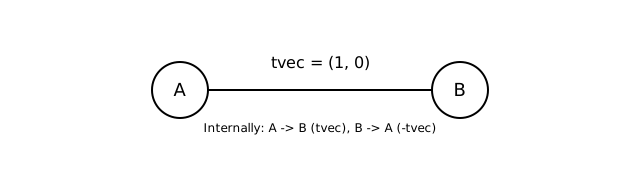
Use PeriodicGraph for undirected periodic graphs where there is at most one edge per (u, v, tvec).
Typical examples:
- Atomic graphs (covalent / ionic / coordination bonds): a single bond relation between two sites.
- Coarse-grained molecular graphs where you treat “molecule A contacts molecule B in this neighbor cell” as a single edge, and store details (multiple atom-atom contacts, energy terms, etc.) in edge attributes.
- Periodic nets where parallel edges are not meaningful.
Notes:
PeriodicGraphis implemented as two directed realizations (u -> vwithtvecandv -> uwith-tvec) that share the same underlying user-attributes dict. The public API returns read-only live views of that mapping (update viaset_edge_attrs()).- Edge identity includes the translation vector: two edges between the same pair of nodes are allowed
if their
tvecdiffer. - Self-loop periodic edges are supported: a quotient edge with
u == vandtvec != 0represents a bond to a periodic image. Internally this uses private keys derived from the base key, but the public API still exposes only integer base keys. - When iterating edges with
keys=True, passtvec=Truefor self-loop periodic edges to distinguish the paired realizations; otherwiseedges(keys=True)can yield duplicate(u, u, key)records.
PeriodicMultiGraph
Use PeriodicMultiGraph when the undirected relation is still natural, but you need multiple distinct
edges for the same (u, v, tvec).
Typical examples:
- Molecular contact graphs where a molecule pair can have multiple physically distinct interactions (e.g., separate hydrogen bonds, pi-stacking, multiple close contacts).
- “Annotated” graphs where you intentionally keep separate edges for different interaction models (e.g., geometric contact vs energy-filtered contact) between the same templates.
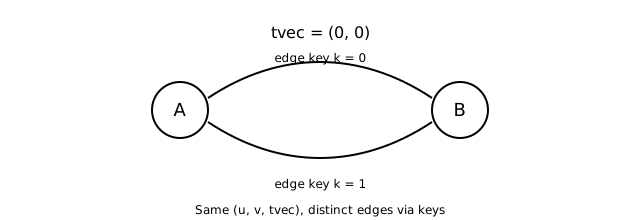
Practical note: if you do not need to distinguish parallel edges algorithmically, it is often simpler
to start with PeriodicGraph and store a list of contact records in a single edge attribute.
PeriodicDiGraph
Use PeriodicDiGraph when edges are intrinsically oriented and there should be at most one edge per
(u, v, tvec).
Examples where direction is meaningful:
- Directed transport / flow models on a periodic lattice (biased random walk, directed percolation).
- Oriented backbones (e.g., polymer directionality) when algorithms want a chosen direction.
- Any periodic state-transition graph (Markov-like) where the relation is not symmetric.
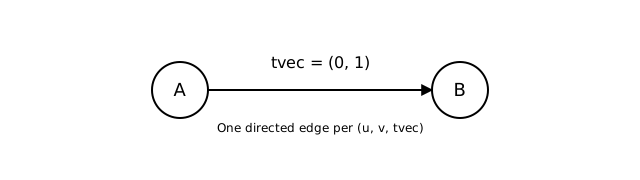
If you only want to label an interaction (e.g., donor/acceptor role), but the relation should still be treated as symmetric for connectivity, an undirected container plus attributes is usually a better fit.
Note
lift_patch(...) follows the container direction: patches extracted from
PeriodicDiGraph / PeriodicMultiDiGraph are directed by default (while
traversal still uses weak connectivity).
PeriodicMultiDiGraph
Use PeriodicMultiDiGraph when edges are directed and multiple distinct edges may exist for the same
(u, v, tvec).
Typical examples:
- Molecular hydrogen-bond graphs with explicit
donor -> acceptordirection, where multiple distinct H-bonds can exist between the same pair of molecules (and the same neighbor cell relation). - Multi-channel directed relations in coarse-grained models.
If you are unsure, start with the simplest container that can represent your semantics, then upgrade to a multi-edge or directed container only when you have a concrete need.