Results
Dataset inventory
The current data layer contains four generated profile/radii/QA datasets. The two primary datasets cover all curated states within their element ranges. The supplemented/augmented branches contain neutral and anion states only; cations are not repeated because compact positive ions are not the main target of basis-tail sensitivity analysis.
| dataset ID | basis | branch role | state scope | profile rows | QA rows |
|---|---|---|---|---|---|
pbe0_sfx2c_x2cqzvpall_h-rn_spherical_v2 |
x2c-QZVPall |
primary H--Rn | H-Rn all curated states | 430 | 430 |
pbe0_sfx2c_dyallv4z_h-lr_spherical_v2 |
dyall-v4z |
primary H--Lr | H-Lr all curated states | 501 | 501 |
pbe0_sfx2c_x2cqzvpalls_h-rn_spherical_v2 |
x2c-QZVPall-s |
supplemented H--Rn | H-Rn neutral and anion states with x2c-QZVPall-s; cations excluded | 192 | 192 |
pbe0_sfx2c_dyallav4z_h-ba_hf-ra_spherical_v2 |
dyall-av4z |
augmented available intervals | H-Ba and Hf-Ra neutral atoms plus selected anions in the same intervals with dyall-av4z; cations excluded | 166 | 166 |
Together, these datasets contain 1289 generated dataset-state rows. A dataset-state row means one state emitted in one basis branch; the same curated state can appear in more than one branch when it participates in a basis comparison.
State and charge coverage
The curated table contains 501 state records. The charge distribution shows the intended scope: neutral atoms, cations through the current charge policy, accepted/provisional monoanions, source-backed diagnostic monoanions, and formal anions.
| charge | curated states |
|---|---|
| -3 | 6 |
| -2 | 20 |
| -1 | 86 |
| 0 | 103 |
| +1 | 102 |
| +2 | 95 |
| +3 | 89 |
The state-role table separates source-backed references from explicitly formal rows. This distinction is essential for interpretation: formal anion rows are useful reference gauges, not claims of isolated stable anions.
| state role | curated states |
|---|---|
| reference | 229 |
| reference_uncertain | 160 |
| bound_experimental | 65 |
| bound_provisional | 4 |
| diagnostic_theory | 3 |
| formal_monoanion | 14 |
| formal_multianion | 26 |
Because the profile branches overlap, the generated-row counts are larger than the curated-state counts. The generated-row distribution below is the effective coverage that downstream consumers see when they read all profile/radii/QA datasets.
| charge | generated dataset-state rows |
|---|---|
| -3 | 24 |
| -2 | 80 |
| -1 | 313 |
| 0 | 348 |
| +1 | 187 |
| +2 | 174 |
| +3 | 163 |
| state role | generated dataset-state rows |
|---|---|
| reference | 594 |
| reference_uncertain | 278 |
| bound_experimental | 247 |
| bound_provisional | 11 |
| diagnostic_theory | 4 |
| formal_monoanion | 51 |
| formal_multianion | 104 |
The generated layer therefore exposes the formal anion rows explicitly rather than hiding them in a generic anion class. This is useful for sensitivity analysis because the formal rows are exactly where low-density tail behavior is expected to be most delicate.
Validation outcomes
The validation summary below reports one row per generated dataset. max |ΔN| is the maximum independent electron-count error in electrons. The angular quantity is the maximum relative angular standard-deviation diagnostic above the QA density floor. Linear-dependency warnings count rows where the backend reported basis linear-dependency handling or dropped primitive behavior.
| dataset ID | basis | rows | failed rows | max |ΔN| | max angular σ/ρ | linear-dependency warnings |
|---|---|---|---|---|---|---|
pbe0_sfx2c_x2cqzvpall_h-rn_spherical_v2 |
x2c-QZVPall |
430 | 0 | 2.30e-12 | 1.56e-14 | 0 |
pbe0_sfx2c_dyallv4z_h-lr_spherical_v2 |
dyall-v4z |
501 | 0 | 2.43e-12 | 3.75e-15 | 266 |
pbe0_sfx2c_x2cqzvpalls_h-rn_spherical_v2 |
x2c-QZVPall-s |
192 | 0 | 2.33e-12 | 3.83e-15 | 38 |
pbe0_sfx2c_dyallav4z_h-ba_hf-ra_spherical_v2 |
dyall-av4z |
166 | 0 | 2.30e-12 | 2.68e-15 | 68 |
All generated rows pass the current validation criteria. The electron-count and angular-sphericity errors are near numerical precision. Linear-dependency warnings are most common in the large Dyall branches and in the supporting comparison branches, but they do not coincide with validation failures in the committed data layer.
| basis | QA rows | LD-warning rows | fraction |
|---|---|---|---|
x2c-QZVPall |
430 | 0 | 0% |
dyall-v4z |
501 | 266 | 53.1% |
x2c-QZVPall-s |
192 | 38 | 19.8% |
dyall-av4z |
166 | 68 | 41.0% |
| all datasets | 1289 | 372 |
The validation result supports using the committed profile/radii/QA layer as the baseline for downstream export and interoperability work. It does not mean that every formal anion is physically stable; it means the generated density row is internally consistent under the declared reference convention.
Multiwfn WFN interoperability validation
A representative local H/O/H2O validation checks the WFN boundary before full Multiwfn artifact generation. The validation writes H and O atom WFNs and an H2O molecule WFN, reads the saved files with the package-side WFN evaluator, and compares Multiwfn plane output against direct PySCF density references. This is an interoperability test for a fixed small system, not a universal validation over the full state table.
| check | points | reference | maximum absolute error | p95 absolute error | RMSE |
|---|---|---|---|---|---|
| H2O WFN read-back spot density | 5 | direct PySCF density | 2.55e-7 | NA | NA |
| O atom spin point, total density | 1 | package WFN evaluator | 2.23e-11 | NA | NA |
| O atom spin point, alpha density | 1 | package WFN evaluator | 3.73e-11 | NA | NA |
| O atom spin point, beta density | 1 | package WFN evaluator | 1.50e-11 | NA | NA |
| H2O deformation plane | 14641 | direct PySCF molecular-minus-atomic density | 1.51e-4 | 3.08e-7 | 2.0e-6 |
| package WFN deformation plane | 14641 | direct PySCF molecular-minus-atomic density | 2.55e-7 | 5.03e-10 | 4.24e-9 |
The O-atom point diagnostic confirms that the current Multiwfn build interprets the generated atom WFN as spin resolved rather than alpha/beta averaged.
| source | total density | alpha density | beta density | spin density |
|---|---|---|---|---|
| package WFN evaluator | 0.502407 | 0.337266 | 0.165141 | 0.172125 |
| Multiwfn point output | 0.502407 | 0.337266 | 0.165141 | 0.172125 |
The standalone molecule and atom plane checks isolate the WFN-density interpretation from the deformation-density arithmetic. For the H2O total-density plane, the package WFN evaluator agrees with direct PySCF to an RMSE of 7.93e-9 e bohr^-3; the larger Multiwfn-minus-reference maximum occurs at the near-nuclear grid point and remains small relative to the maximum plane density. The H and O atom planes show the same pattern at smaller scale. The documentation notebook docs/notebooks/multiwfn_wfn_plane_validation.ipynb records the local workflow and the compact result tables.
Primary basis-family comparison
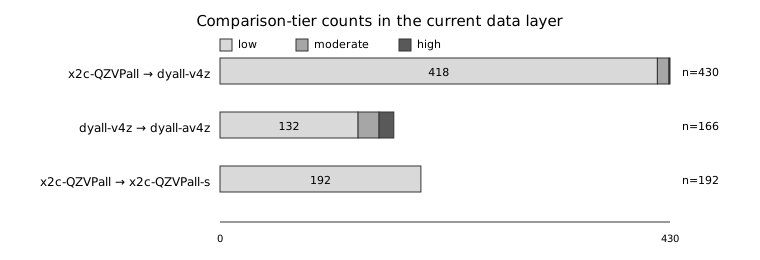
The primary comparison matches x2c-QZVPall and dyall-v4z over the H--Rn overlap by exact state_id and state-record digest. The comparison tests how two primary all-electron scalar-relativistic basis families change the same spherical reference state. It is not a diffuse-basis test.
| comparison | matched states | integrity/validation failures | low | moderate | high | outliers | max relative L1 | max sup |ΔN(r)| / e | max |ΔR_cut| / Å |
|---|---|---|---|---|---|---|---|---|---|
x2c-QZVPall → dyall-v4z |
430 | 0 | 418 | 11 | 1 | 1 | 0.163 | 0.811 | 1.040 |
Most matched states are in the low-difference tier. The single high-difference row is a formal multianion, C_qm3_mult2_formal. The table below groups the same comparison by charge. The relative L1 columns summarize redistribution in the radial distribution \(D(r)=4\pi r^2\rho(r)\), while sup |ΔN(r)| summarizes the largest cumulative electron-count separation at any radius.
| comparison | charge | n | low | moderate | high | median rel. L1 | p95 rel. L1 | max rel. L1 | max sup |ΔN(r)| / e | max |ΔR_cut| / Å |
|---|---|---|---|---|---|---|---|---|---|---|
x2c-QZVPall → dyall-v4z |
-3 | 6 | 1 | 4 | 1 | 0.0567 | 0.1561 | 0.1631 | 0.8106 | 0.6431 |
x2c-QZVPall → dyall-v4z |
-2 | 20 | 15 | 5 | 0 | 0.0209 | 0.0938 | 0.0946 | 0.5924 | 0.7169 |
x2c-QZVPall → dyall-v4z |
-1 | 80 | 78 | 2 | 0 | 0.0063 | 0.0258 | 0.1165 | 0.4680 | 1.0401 |
x2c-QZVPall → dyall-v4z |
0 | 86 | 86 | 0 | 0 | 0.0011 | 0.0022 | 0.0046 | 0.0136 | 0.0309 |
x2c-QZVPall → dyall-v4z |
+1 | 85 | 85 | 0 | 0 | 0.0009 | 0.0022 | 0.0040 | 0.0136 | 0.0363 |
x2c-QZVPall → dyall-v4z |
+2 | 79 | 79 | 0 | 0 | 0.0008 | 0.0017 | 0.0021 | 0.0136 | 0.0218 |
x2c-QZVPall → dyall-v4z |
+3 | 74 | 74 | 0 | 0 | 0.0009 | 0.0024 | 0.0040 | 0.0243 | 0.0234 |
The distribution table gives all-state quantiles for the main scalar diagnostics. Median primary-basis differences are small. The upper tail is driven by anionic and especially formal anionic references, where radial tails and weak binding are expected to be more basis-sensitive than compact neutral or cationic states.
| metric | n | p50 | p90 | p95 | p99 | max |
|---|---|---|---|---|---|---|
| relative L1 | 430 | 0.0011 | 0.0098 | 0.0185 | 0.0944 | 0.1631 |
| sup |ΔN(r)| / e | 430 | 0.0078 | 0.1978 | 0.2968 | 0.5974 | 0.8106 |
| mean |radial shift| / Å | 430 | 0.0001 | 0.0131 | 0.0215 | 0.0837 | 0.1511 |
| max |ΔR_cut| / Å | 430 | 0.0079 | 0.1655 | 0.3644 | 0.6766 | 1.0401 |
| |Δ tail N(r>5 bohr)| / e | 430 | 0.0006 | 0.0562 | 0.1691 | 0.4526 | 0.8069 |
| |Δ tail N(r>10 bohr)| / e | 430 | 5.9065e-06 | 0.0275 | 0.1421 | 0.2971 | 0.3697 |
| |Δ tail N(r>15 bohr)| / e | 430 | 9.8850e-09 | 0.0002 | 0.0063 | 0.0726 | 0.1061 |
| |Δ tail N(r>20 bohr)| / e | 430 | 8.0311e-12 | 3.5948e-07 | 0.0000 | 0.0033 | 0.0104 |
The outlier row is shown explicitly so that downstream users can decide whether it matters for their application. It should be treated as a scientific sensitivity flag for a formal reference state rather than as evidence of corrupted generated data.
| state ID | element | charge | state role | tier | rel. L1 | sup |ΔN(r)| / e | max |ΔR_cut| / Å | flags |
|---|---|---|---|---|---|---|---|---|
C_qm3_mult2_formal |
C | -3 | formal_multianion | high | 0.1631 | 0.7189 | 0.4980 | relative_l1_outlier;cumulative_delta_watch;mean_radial_shift_watch |
Supplemented/augmented basis sensitivity
The supplemented/augmented comparison uses the same matched-state contract but compares a primary branch with its supporting branch. The current neutral-plus-anion supporting branches are unified by basis identity rather than split into separate neutral and anion datasets. The two comparisons are not equivalent: dyall-av4z is an augmented Dyall branch, whereas x2c-QZVPall-s is an NMR-shielding-oriented supplemented x2c branch rather than a standard diffuse tail basis.
| comparison | matched states | integrity/validation failures | low | moderate | high | outliers | max relative L1 | max sup |ΔN(r)| / e | max |ΔR_cut| / Å |
|---|---|---|---|---|---|---|---|---|---|
dyall-v4z → dyall-av4z |
166 | 0 | 132 | 20 | 14 | 14 | 0.383 | 1.661 | 2.127 |
x2c-QZVPall → x2c-QZVPall-s |
192 | 0 | 192 | 0 | 0 | 0 | 0.014 | 0.033 | 0.020 |
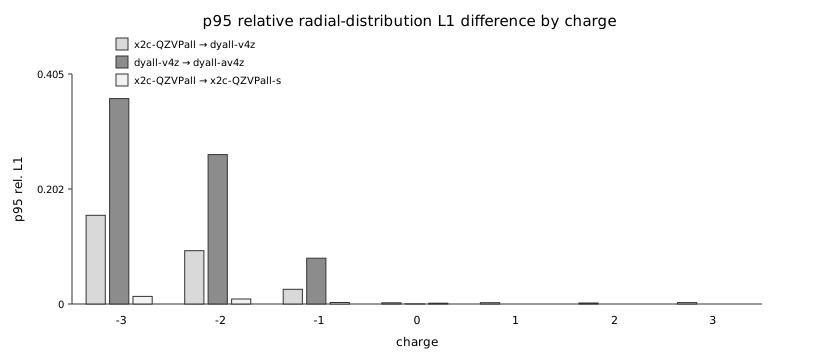
The x2c supplemented branch is uniformly low-sensitivity in the current data, which is consistent with treating it as a branch that most density-reference users can ignore. The Dyall augmented branch has 14 high-sensitivity rows, all in formal anion references. This pattern is visible when the data are grouped by charge.
| comparison | charge | n | low | moderate | high | median rel. L1 | p95 rel. L1 | max rel. L1 | max sup |ΔN(r)| / e | max |ΔR_cut| / Å |
|---|---|---|---|---|---|---|---|---|---|---|
dyall-v4z → dyall-av4z |
-3 | 6 | 0 | 0 | 6 | 0.1186 | 0.3615 | 0.3834 | 1.6607 | 1.8616 |
dyall-v4z → dyall-av4z |
-2 | 20 | 3 | 10 | 7 | 0.0528 | 0.2630 | 0.2935 | 1.1532 | 1.6452 |
dyall-v4z → dyall-av4z |
-1 | 67 | 56 | 10 | 1 | 0.0048 | 0.0805 | 0.2175 | 0.7016 | 2.1275 |
dyall-v4z → dyall-av4z |
0 | 73 | 73 | 0 | 0 | 0.0000 | 0.0002 | 0.0004 | 0.0022 | 0.0071 |
x2c-QZVPall → x2c-QZVPall-s |
-3 | 6 | 6 | 0 | 0 | 0.0018 | 0.0134 | 0.0138 | 0.0326 | 0.0135 |
x2c-QZVPall → x2c-QZVPall-s |
-2 | 20 | 20 | 0 | 0 | 0.0004 | 0.0088 | 0.0095 | 0.0185 | 0.0197 |
x2c-QZVPall → x2c-QZVPall-s |
-1 | 80 | 80 | 0 | 0 | 0.0005 | 0.0027 | 0.0042 | 0.0107 | 0.0134 |
x2c-QZVPall → x2c-QZVPall-s |
0 | 86 | 86 | 0 | 0 | 0.0005 | 0.0015 | 0.0018 | 0.0107 | 0.0059 |
The state-role grouping makes the interpretation clearer: high sensitivity is concentrated in formal monoanion/multianion rows rather than neutral references or source-backed experimental monoanions.
| comparison | state role | n | low | moderate | high | median rel. L1 | max rel. L1 |
|---|---|---|---|---|---|---|---|
dyall-v4z → dyall-av4z |
reference | 73 | 73 | 0 | 0 | 0.0000 | 0.0004 |
dyall-v4z → dyall-av4z |
bound_experimental | 56 | 52 | 4 | 0 | 0.0036 | 0.1030 |
dyall-v4z → dyall-av4z |
bound_provisional | 1 | 0 | 1 | 0 | 0.0138 | 0.0138 |
dyall-v4z → dyall-av4z |
diagnostic_theory | 1 | 1 | 0 | 0 | 0.0005 | 0.0005 |
dyall-v4z → dyall-av4z |
formal_monoanion | 9 | 3 | 5 | 1 | 0.0290 | 0.2175 |
dyall-v4z → dyall-av4z |
formal_multianion | 26 | 3 | 10 | 13 | 0.0549 | 0.3834 |
x2c-QZVPall → x2c-QZVPall-s |
reference | 86 | 86 | 0 | 0 | 0.0005 | 0.0018 |
x2c-QZVPall → x2c-QZVPall-s |
bound_experimental | 63 | 63 | 0 | 0 | 0.0005 | 0.0042 |
x2c-QZVPall → x2c-QZVPall-s |
bound_provisional | 3 | 3 | 0 | 0 | 0.0005 | 0.0005 |
x2c-QZVPall → x2c-QZVPall-s |
formal_monoanion | 14 | 14 | 0 | 0 | 0.0007 | 0.0039 |
x2c-QZVPall → x2c-QZVPall-s |
formal_multianion | 26 | 26 | 0 | 0 | 0.0004 | 0.0138 |
The high-sensitivity Dyall augmented rows are listed below. They are mainly light and p-block formal anions, with the strongest relative L1 response for C_qm3_mult2_formal. The large cutoff-radius shifts show that the augmented basis changes low-density tails and cumulative radial redistribution, not the integer electron count.
| state ID | element | charge | state role | tier | rel. L1 | sup |ΔN(r)| / e | max |ΔR_cut| / Å | flags |
|---|---|---|---|---|---|---|---|---|
Be_qm1_mult2_formal |
Be | -1 | formal_monoanion | high | 0.2175 | 0.5384 | 1.1900 | relative_l1_outlier;cumulative_delta_watch;mean_radial_shift_outlier |
B_qm2_mult4_formal |
B | -2 | formal_multianion | high | 0.2935 | 1.0184 | 1.6333 | relative_l1_outlier;cumulative_delta_outlier;mean_radial_shift_outlier |
C_qm3_mult2_formal |
C | -3 | formal_multianion | high | 0.3834 | 1.6607 | 1.8616 | relative_l1_outlier;cumulative_delta_outlier;mean_radial_shift_outlier |
C_qm2_mult3_formal |
C | -2 | formal_multianion | high | 0.2251 | 0.8674 | 1.5880 | relative_l1_outlier;cumulative_delta_watch;mean_radial_shift_watch |
N_qm3_mult1_formal |
N | -3 | formal_multianion | high | 0.2957 | 1.4680 | 1.6062 | relative_l1_outlier;cumulative_delta_outlier;mean_radial_shift_outlier |
N_qm2_mult2_formal |
N | -2 | formal_multianion | high | 0.2614 | 1.1532 | 1.6452 | relative_l1_outlier;cumulative_delta_outlier;mean_radial_shift_outlier |
Al_qm2_mult4_formal |
Al | -2 | formal_multianion | high | 0.1386 | 1.0191 | 1.2948 | relative_l1_watch;cumulative_delta_outlier;mean_radial_shift_watch |
P_qm3_mult1_formal |
P | -3 | formal_multianion | high | 0.1587 | 1.4073 | 1.6637 | relative_l1_outlier;cumulative_delta_outlier;mean_radial_shift_watch |
Ga_qm2_mult4_formal |
Ga | -2 | formal_multianion | high | 0.0667 | 1.0836 | 1.1706 | relative_l1_watch;cumulative_delta_outlier;mean_radial_shift_watch |
As_qm3_mult1_formal |
As | -3 | formal_multianion | high | 0.0786 | 1.3931 | 1.6705 | relative_l1_watch;cumulative_delta_outlier;mean_radial_shift_watch |
In_qm2_mult4_formal |
In | -2 | formal_multianion | high | 0.0418 | 1.0468 | 0.9184 | cumulative_delta_outlier |
Sb_qm3_mult1_formal |
Sb | -3 | formal_multianion | high | 0.0510 | 1.3528 | 1.6587 | relative_l1_watch;cumulative_delta_outlier |
Tl_qm2_mult4_formal |
Tl | -2 | formal_multianion | high | 0.0276 | 1.1325 | 1.1864 | cumulative_delta_outlier |
Bi_qm3_mult1_formal |
Bi | -3 | formal_multianion | high | 0.0328 | 1.3868 | 1.7081 | cumulative_delta_outlier |
Practical result
The current data layer supports a clear default policy. Use the primary branches for reproducible default analyses: x2c-QZVPall for H--Rn when that element range is sufficient, and dyall-v4z for the broader H--Lr branch. Most users can ignore x2c-QZVPall-s; it is retained as an auditable supplemented comparison branch, not as the recommended tail-convergence reference. When low-density tails are central to the scientific question, prefer the Dyall primary/augmented comparison where its element coverage exists, and report formal-anion sensitivity explicitly.
The supplemented/augmented branches should not be silently substituted into the primary dataset. They are separate reference gauges. Their value is precisely that they make basis-tail sensitivity observable and auditable.
Next: Discussion.